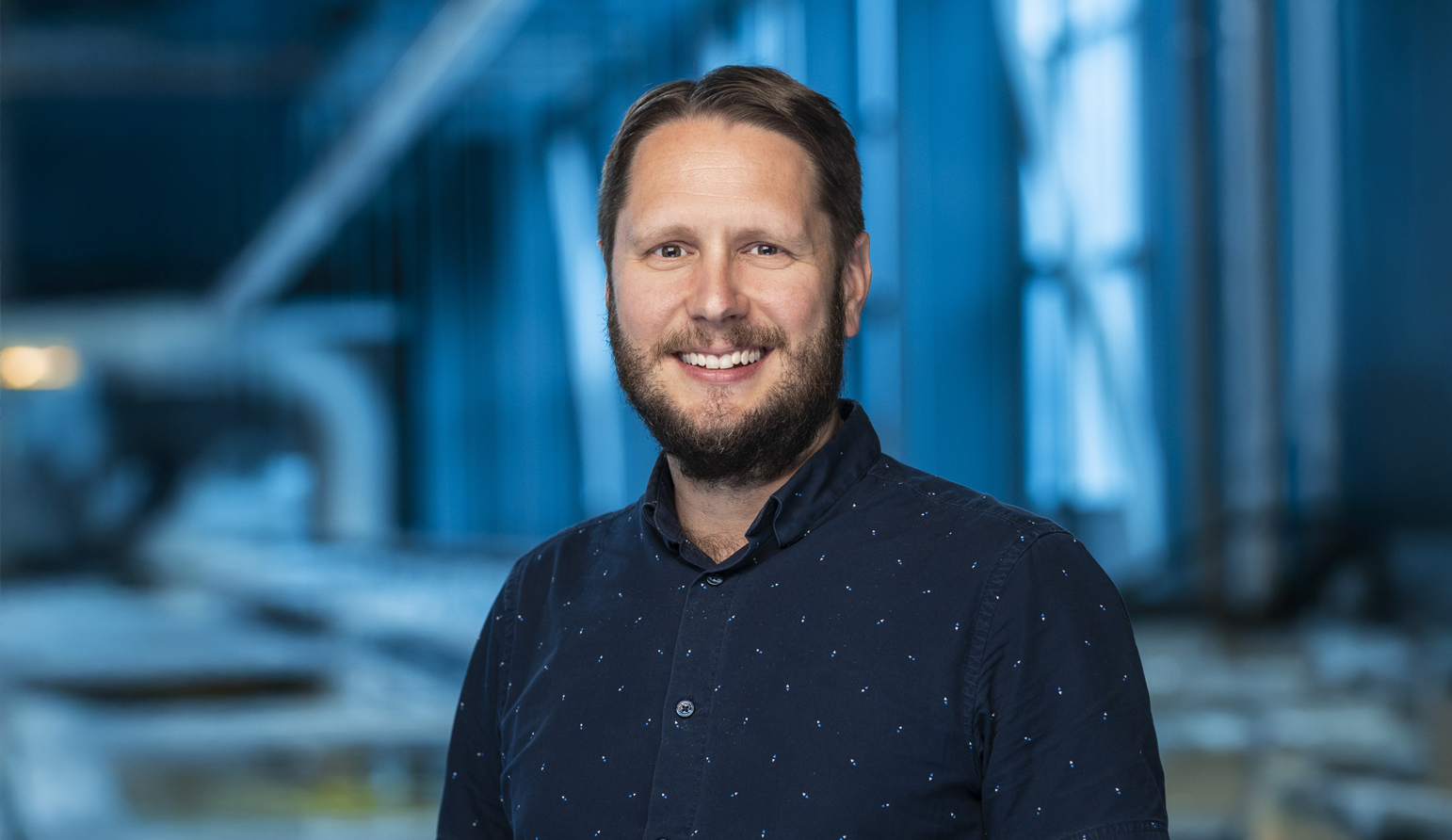
When Burke Barlow first stepped into a chemistry lab at the University of Saskatchewan, he didn’t know that his curiosity about corrosion and electrochemistry would eventually lead him to a career at one of Canada’s most advanced research facilities.
Today, Burke works in the Industry Services group at the Canadian Light Source (CLS), using cutting-edge tools like synchrotron light (electromagnetic radiation) and electron microscopy to help solve real-world challenges in mining and materials science.
Between those two points is a story about what happens when industry, universities, and organizations like the International Minerals Innovation Institute (IMII) work together.
IMII’s support has quietly been part of Burke’s journey at key moments – first as a graduate student, and now as an industry-facing scientist.
Building a Foundation: Corrosion, Concrete, and a Career Turning Point
Burke was born and raised in Saskatchewan and completed both his bachelor’s and master’s degrees in chemistry at the University of Saskatchewan. His connection to industry-focused research started early, working in Professor Ian Burgess’s lab in an undergraduate honours project.
After taking a break from science to explore other paths, Burke decided he wanted to return. What started as a simple request for a reference from his former supervisor turned into something bigger: a job in his lab working on the NSERC-funded project related to nickel electroplating that ended up becoming his master’s thesis. This role also led to an offer to join a new IMII-funded research project on concrete corrosion.
The project focused on understanding the corrosion of reinforcing bar in concrete – a critical issue for long-term infrastructure safety in industrial environments.
Using synchrotron radiation at CLS, Burke and the team examined corrosion through protective coatings, mapping elements like iron, manganese, chlorine, and potassium at the interface between the metal and the coating. This work allowed them to visualize how corrosion progressed beneath the surface, reinforce existing theories about corrosion mechanisms, and achieve far higher resolution than earlier studies.
For industry, this kind of work helps inform better coating selection and maintenance strategies – ultimately supporting safer, longer-lasting infrastructure in harsh environments like mines, mills, and processing plants.
For Burke, it was a turning point.
By the time he applied to CLS, he had two major industry collaborations behind him – including the IMII concrete corrosion project. That experience, he says, was “pretty instrumental” in landing his current role.
From Corrosion to Potash: Meeting New Industry Needs
Today, Burke’s work continues to bridge advanced science and on-the-ground industry challenges. One of his current projects, again supported through IMII, focuses on something that’s easy to overlook but critically important in potash production: dedusting agents.
Potash producers add small amounts of dedusting agents to control dust, manage how the product behaves in different humidity conditions, and reduce issues like caking during storage and transport. The challenge is finding additives that are effective at suppressing dust, biodegradable and environmentally safe, and used in the smallest possible quantities since they add cost and weight but no fertilizer value.
In this IMII-supported project, led by CLS Industry Services Scientist Peter Blanchard, Burke’s role is to use electron microscopy to see how different dedusting agents coat the surface of potash particles and how the behaviour of the dedusting agent changes with temperature and humidity.
Electron microscopy uses a focused beam of electrons instead of light, producing highly detailed images and generating X-rays that reveal a sample’s elemental makeup. In practical terms, this allows Burke to image a single potash particle, showing exactly where the dusting agent sits on the surface, distinguishing between petroleum-based dedusting agent and the potash.
Another part of the project uses CT (computed tomography) to create 3D reconstructions of potash particles and visualize how deeply these agents penetrate.
The ultimate goal is to give mining companies a much clearer understanding of how dedusting agents bind to potash at the microscopic level. This will help the potash industry develop and use environmentally friendly alternatives to the current industry standards.
It’s a perfect example of how applied research can support both safety and sustainability in Saskatchewan’s minerals sector.
Fostering Innovation Capacity for a Changing Industry
The skills Burke gained through IMII-supported projects continue to influence his work today. He collaborates with university researchers on new corrosion projects, including coatings and alloys for technologies like small modular reactors. He works closely with industry partners who rely on sophisticated tools and expertise to solve complex problems. And he demonstrates the value of Saskatchewan-based talent and facilities like the Canadian Light Source to mining companies across the province.
In this way, IMII’s role extends far beyond a single project or grant. It helps cultivate a talent pipeline and an innovation ecosystem where students evolve into specialists with industry-ready experience, companies gain access to local experts who understand their challenges, and Saskatchewan continues to punch above its weight in mining innovation.
Why IMII Collaborations Matter
Neither of Burke’s IMII-linked projects exists in isolation. They are part of a wider network of collaborations involving university researchers, the Canadian Light Source, Saskatchewan mining companies, with IMII as the coordinating and funding catalyst.
By bringing these groups together, IMII ensures that industry needs shape research questions, that students and emerging researchers gain meaningful real-world experience, and that the solutions developed contribute to a safer, more sustainable minerals industry.
From concrete corrosion studies to potash dusting agent analysis, these projects are helping Saskatchewan’s mining sector make better-informed decisions while supporting the growth of the highly skilled people who will guide the industry into the future. Because when you invest in Highly Qualified People, you are not just supporting one career – you are helping build a safer, smarter, and more sustainable mining industry for the province as a whole.