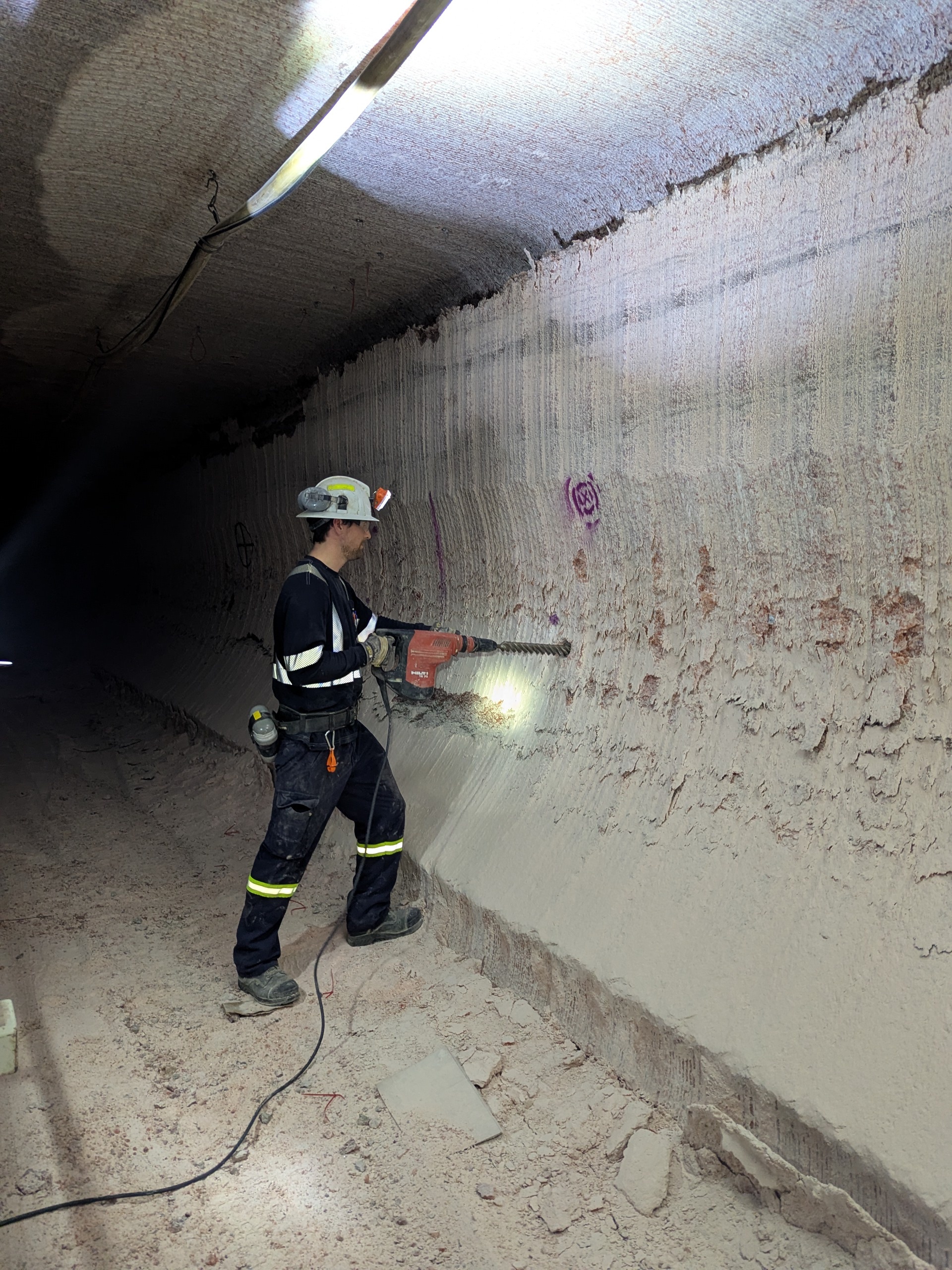
When Garrett Snell graduated from the University of Saskatchewan in 2015 with a clear passion for rock mechanics, he knew exactly where he wanted his career to go – he just needed the opportunity to get started. Today, Garrett is a PhD researcher whose work is informing real-time decisions in potash mines across the province and around the world. His path is an example of how IMII’s support for developing knowledge and people that strengthens both Saskatchewan’s workforce and its mining industry.
And in Garrett’s words, “I don’t see any other way this could have happened without IMII.”
A First Opportunity: Understanding Rockbolt Behaviour
Garrett’s journey with IMII began shortly after completing his bachelor’s degree, when funding made it possible for him to pursue a master’s in rock mechanics. At the time, potash companies were looking for answers to a complex ground support problem:
How do rockbolts behave under shear — when rock masses move sideways rather than simply pulling apart?
Through IMII’s collaboration model, PotashCorp and Agrium (now Nutrien) and Mosaic were brought together under a single project umbrella. IMII helped coordinate funding, industry participation, and site access. This structure gave Garrett something invaluable as an emerging researcher:
- Field experience in active mines
- Exposure to multiple operational environments
- A problem defined directly by industry needs
The results of his research have since been applied in Saskatchewan potash operations to determine when and where rockbolts may require rehabilitation – improving both decision-making and onsite safety.
Garrett notes that even years later, he still meets people underground who know his work:
“Many potash mines are using my research to evaluate shear on their rockbolts.”
Returning to Research: A New Project with Real-World Safety Implications
After several years working across Canada, the U.S., Australia, New Zealand, and beyond, Garrett found himself pulled back toward research – and back toward IMII-supported work.
With a young family at home and a desire to tackle deeper technical questions, he returned to the University of Saskatchewan to begin a PhD focused on pillar stability and stress behaviour in active potash mines.
Again, IMII played a crucial role in bringing companies together to support a shared challenge:
How can we accurately evaluate the stresses within underground pillars – the rock left in place between tunnels – to ensure long-term safety and prevent costly rehabilitation or closure?
The project, which is funded by Nutrien, Mosaic, BHP and Mitacs/NSERC involves installing advanced instruments in active potash pillars to measure pressure, deformation, and stress changes over time. Early installations have already produced meaningful insights, with further work set to continue into next year.
This research directly affects operational safety. Unstable pillars can deform, fail, or force companies to abandon entire areas underground. Garrett’s work strives to help mine operators better predict stability and make critical decisions that keep miners safe.
IMII’s Long-Term Impact: Building Knowledge and Highly Qualified Workforce Capacity for Saskatchewan
Throughout Garrett’s academic and professional trajectory, IMII has been a steady partner – not only funding individual projects but creating the conditions for Saskatchewan to develop and retain world-class expertise.
Garrett reflects on this impact, “I’m quite external to IMII, yet they funded my early career and now my mid-career. They’re the reason I was able to do this research. It’s been pretty vital to my progression.”
He also highlights a broader truth about Saskatchewan’s minerals sector:
“We’re a relatively small province, but we punch way above our weight in mining. Developing our expertise locally is major – even a few dozen highly specialized people can have a huge impact on the industry.”
This is exactly why IMII invests in knowledge and workforce development: because building talent in Saskatchewan means building the future of the province’s mining industry.
A Safer, Stronger Industry – Powered by Saskatchewan Research
Garrett’s IMII-supported projects share a common thread: research that directly improves operational safety and supports the long-term sustainability of Saskatchewan’s potash industry.
Garrett’s work will leverage new knowledge and understanding to
- Reduce risk underground
- Inform critical engineering decisions
- Support responsible resource extraction
- Strengthen Saskatchewan’s rock mechanics and mining expertise
Behind each of these advancements is IMII’s commitment to developing people – the engineers, researchers, and innovators who will lead the industry forward to deliver a safer, more resilient, and more innovative mining sector for generations to come.